

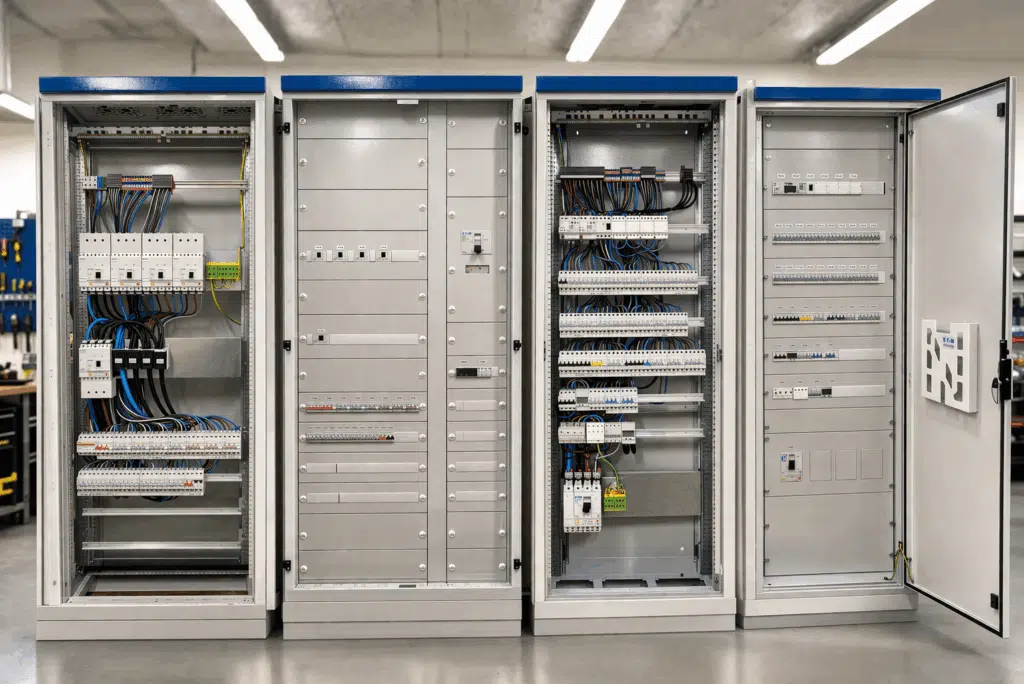
Sub distribution boards built for modern electrification
A sub distribution board (sub panel) receives power from the main distribution board and distributes it to circuits within a building.
At Elskap AS, we design and manufacture sub distribution boards for residential, commercial and industrial installations – tailored for load capacity, selectivity and future expansion.
- Efficient and structured power distribution
- Flexible and modular design
- Built for EV charging, solar and modern installations
- Designed for practical installation and long-term reliability
Sub distribution boards are used to reduce cable lengths, improve system flexibility and provide local protection of circuits.
Looking for a sub distribution board for your project?
👉 Get in touch with Elskap AS for a tailored solution.
🔌 What is a sub distribution board used for?
A sub distribution board allows power to be distributed more efficiently in larger installations. Instead of long cable runs directly from the main distribution board, sub distribution boards are installed closer to the loads.
Typical applications:
- Garages
- Basements
- Floors in residential and commercial buildings
- Workshops and technical rooms
⚡ Difference between main distribution board and sub distribution board
The main distribution board is the central electrical distribution point where power enters the building.
A sub distribution board:
- receives power from the main distribution board
- distributes power to smaller areas
- provides local protection and better overview
👉 In short:
Main distribution board = main supply
Sub distribution board = local distribution
📋 Design requirements – FEL §16 (Norwegian regulations)
Electrical installations in Norway must be designed according to the principle of “intended use”.
This means:
- correct dimensioning of protection devices and cables
- assessment of load and usage
- adaptation for both current and future needs
📏 Typical sizes and capacities
sub panels are dimensioned based on the installation.
Typical ranges:
- up to 125 A (smaller installations)
- up to 250 A (typical residential and commercial use)
- above 250 A (larger systems)
Correct sizing is essential for both current demand and future expansion.
🔄 IT and TN systems
Sub panels are designed for different systems:
- TN-S 400V – common in modern installations
- IT / TT 230V – used in parts of Norway
The system affects both design and component selection.
⚡ Neutral conductor in TN systems – important concept
In Norwegian TN systems, the neutral conductor is considered a live conductor.
This affects protection design:
- all-pole protection is normally used
- ensures complete disconnection of the circuit
⚠️ Neutral conductor, UPS and generator systems
When upgrading installations with UPS or generator systems, it is critical to verify how the neutral conductor is handled.
If the neutral is interrupted:
- voltage imbalance may occur
- overvoltage can damage equipment
- risk of serious system failure
📌 Key principle:
A properly connected neutral conductor is essential for safe and stable operation.
📍 Placement of sub distribution boards
power distribution panel are typically installed close to the loads they supply, downstreams the Main distribuition board.
Common locations:
- technical rooms
- basements
- garages
- building floors
Good placement ensures:
- shorter cable runs
- better accessibility
- easier maintenance
⚠️ Common mistakes
Typical issues we see:
- insufficient capacity
- poor placement
- no allowance for future expansion
- lack of selectivity
👉 This often leads to costly upgrades later.
⚡ Selectivity in sub distribution boards
Selectivity ensures that only the protective device closest to a fault disconnects.
This means:
- faults do not shut down the entire system
- only the affected circuit is disconnected
- improved operational reliability
📋 Standards and requirements
Sub distribution boards must comply with strict international standards to ensure safety, performance and reliability, including:
- NEK 400
- EN 61439
This ensures:
- safe installation
- proper protection
- long-term reliability
According to the EN 61439 standard, distribution boards must be designed and tested for safety and performance.
📌 Installation guidelines must be followed
All equipment must be installed according to the manufacturer’s instructions to ensure safe operation and long-term reliability.
This includes:
- correct tightening of connections
- proper assembly
- maintaining IP rating
- thermal considerations
⚠️ Limitations for operation
For installations intended for non-qualified users:
- maximum upstream protection: typically 250 A
- maximum short-circuit level: 10 kA
📜 Intended use principle
The installation must be designed according to actual use – not just theoretical compliance.
👉 The solution must be correct both technically and functionally.
❓ FAQ
What is the difference between a main distribution board and a sub distribution board?
The main distribution board is the central point where power enters the building, while the sub distribution board distributes power further to smaller areas.
Where are sub distribution boards used?
They are used in residential, commercial and industrial installations where power needs to be distributed locally.
Can sub distribution boards be customized?
Yes, all solutions are designed based on the specific project requirements.
What happens if the neutral conductor is interrupted?
This can cause voltage imbalance and potentially serious damage to connected equipment.
Are there standards for sub distribution boards?
Yes, they must comply with standards such as NEK 400 and EN 61439.
🔧 Panel builder of sub distribution boards
A sub distribution board is a critical part of the electrical system and must be designed and built for both performance and reliability.
At Elskap AS, we deliver solutions tailored for real-world installations – with focus on practical assembly, capacity and long-term operation.
👉 Our solutions are designed for load, selectivity and future expansion – based on real installation experience.
See also our connection cabinets.
